Math your child will actually understand
Interactive lessons with animations, games, exercises with step-by-step guided solutions, and an assistant that teaches children to think — not just hand them answers. The whole 5th-grade curriculum in one place.
What's inside
Everything your child needs to learn math independently and actually understand it.
Interactive lessons
10 chapters covering the full 5th-grade curriculum, each with animations that show step by step how a concept works.
Guided exercises
Problems with solutions broken into steps — your child sees the path to the answer, not just the answer itself.
Printable PDF worksheets
Ready-made exercise sets to print and solve offline — great for reviewing before a test.
Badges, stickers and certificates
Your child can see their progress chapter by chapter, earn badges and stickers, and get a printable certificate for every chapter completed.
4 visual themes
Friendly, Pixel, Storybook, or Clay — your child picks the look they want to learn in.
3 languages
The whole app runs in Polish, English, and Ukrainian — your child learns in the language they're most comfortable in.
Assistant generates new exercises
When your child asks for another example, the assistant invents a fresh, similar problem to practice — no more repeating the exact same content.
Learn at your own pace
No time limit, no pressure — your child can return to the same lessons and exercises as many times as it takes to truly understand a topic. Parents can finally relax.
Got a question? Reach out
A contact form built right into the app — tell us about a topic your child is currently working through, or ask us anything else.
Lesson 5 of 9
- What are factors
- What are multiples
- Greatest common factor
- Least common multiple
Learning your child comes back to
Lessons and exercises are the core. On top of that: games, word problems solved step by step, and geometry tools to practise on screen.
13 maths games
Short 1–3 minute rounds, each tied to a topic from the curriculum: times tables against the clock, fractions, negative numbers, angles, area, the clock, percentages. Your child beats their own record — no rankings, no comparing with others.
- Sprint
- Number line target
- Memory
- Bigger or smaller?
- Catch the divisible
- Angle by eye
- Make a whole
- Give change
- Clock
- Colour a percentage
- Find the area
- Cube net
- Number target
Word problems, step by step
This is where children get stuck most often. They solve every problem with the same method and a drawing that shows what to calculate:
- What do I know?
- What am I looking for?
- Drawing
- Which operation?
- Calculation
- Answer in a full sentence
8 topics: how many more and how many times, shopping and change, parts and the whole, fraction of a number, percentages, speed, clock and calendar, area in real life.
Ruler, protractor and set square on screen
The app first shows how to place the tool, then lets your child try: slide the ruler, place the protractor, guide the set square — and see straight away whether it was right.
- A segment of given length
- Measuring an angle
- Drawing an angle
- Perpendicular line
- Parallel line
The protractor has two scales, just like the one in the pencil case — your child learns which one to read.
A daily dose of motivation
A puzzle of the day on the dashboard, a sticker album for points and completed sections, and a printable certificate for every section finished. And a moment of joy on screen for every correct answer.
Puzzle of the day — free, on a free accountWant to learn to solve a Rubik's cube? Now you can!
New for years 5 and 6: Cube Academy. Eight short stages take your child from the first move to a solved 3×3 cube. Your child holds a real cube, and the app shows in pictures, move by move, what to do — with an arrow, an animation and a narrator.
- Meet the cube
- Daisy and white cross
- White corners
- Middle layer
- Yellow cross
- Yellow edges
- Corners into place
- The last turn
A calm pace with no timer: three breaths to start, a mood diary after each stage. A badge for every stage and, at the end, a printable Cube Master diploma.
The first two stages — freeNew: 3D tests — an expedition through a land
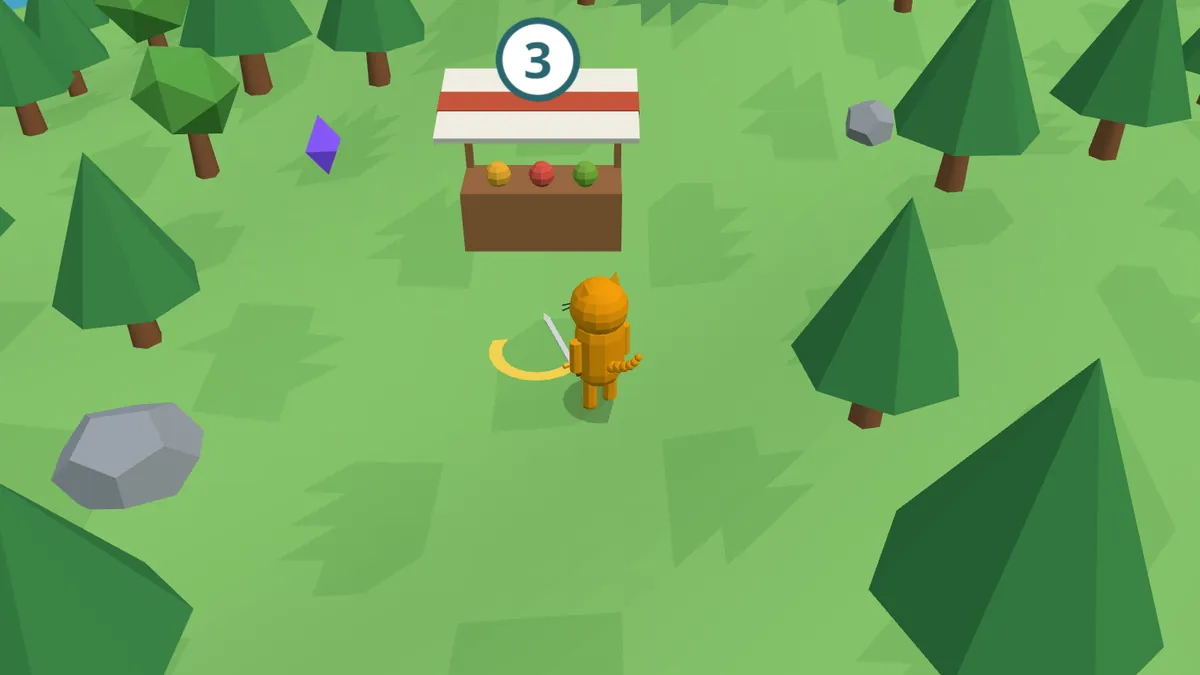
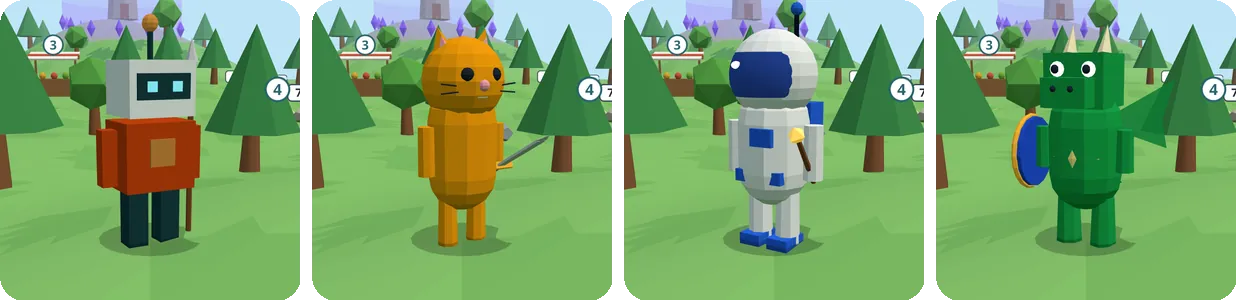
A unit test doesn’t have to feel like a quiz. A year 5 pupil chooses a character — a robot, a cat, an astronaut or a dragon — and sets off on an expedition across Number Island or Shape Valley. Five stations hold tasks from the whole unit, and the summit tower opens only after the first four.
- Number Island — natural numbers
- Shape Valley — figures and angles
- Different tasks every time
- A stone bridge, e.g. numbers divisible by 3
- Treasure at the end of the bridge
The tasks are different every time and use different numbers, so the answers can’t be learned by heart. The result counts like a regular unit test, and at the end the game suggests which lessons are worth revising. It works on a computer, tablet and phone; 3D tests are part of the subscription.
The assistant guides. It doesn't solve the problem for your child.
When a child gets stuck on a problem, the assistant doesn't just hand over the answer. It asks guiding questions, reminds them of the rule they need, and nudges them toward the next step — the way a good tutor would, someone who actually wants the student to understand the topic, not just tick a box.
That difference matters: your child leaves every study session a little smarter, not just with a finished worksheet.
Sample conversation — an illustration of how the assistant works.
Why it's worth it
An hour of online tutoring usually costs 70-100 zł. A full month of unlimited access to the app costs 35 zł.
See it in action
Thirty seconds from the long division animation: the child sees every step with the explanation right beside it.
30 seconds, with sound — nothing plays until you click. The captions in the recording are Polish; the app itself is fully available in English.
Take a ready-made test. Free, no account.
Three pages, 23 tasks, about 45 minutes — the whole "Natural numbers" chapter. Print it out and solve it with a pencil, away from the screen.
Test: Natural Numbers — grade 5
Printable PDF, 3 pages. No sign-up, no email address needed.
Download the PDFExactly what is inside
The full list of chapters and lessons. Open a chapter to see what it teaches.
11 chapters, 116 lessons
Warm-upfree8 lessons
- Times tables
- Mental maths
- Big numbers and the number line
- Parts of a whole
- Złoty and grosz
- Clock, calendar and units
- Lines and angles
- Rectangles, areas and boxes
Natural Numbersfree14 lessons
- Natural Numbers and the Number Line
- Writing and Comparing Numbers
- Addition and Subtraction
- Mental Addition and Subtraction
- Multiplication and Division
- Mental Multiplication and Division
- Order of Operations
- Estimating Results
- Rounding Natural Numbers
- Factors and Multiples
- Divisibility Rules
- Prime and Composite Numbers
- Powers: Square and Cube
- Word Problems
Common Fractions11 lessons
- What Is a Fraction
- Proper and Improper Fractions
- Mixed Numbers
- Expanding and Reducing Fractions
- Common Denominator and Comparing Fractions
- Adding and Subtracting Fractions with the Same Denominator
- Adding and Subtracting Fractions with Different Denominators
- Operations on Mixed Numbers
- Multiplying Fractions
- Dividing Fractions
- Comparing fractions
Decimal Fractions10 lessons
- Decimal Notation for Fractions
- Comparing Decimal Numbers
- Adding and Subtracting Decimal Numbers
- Multiplying and Dividing by 10, 100, 1000
- Multiplying Decimal Numbers
- Dividing Decimal Numbers
- Rounding Decimal Numbers
- Converting Fractions to Decimals and Back
- Practical Calculations with Decimal Numbers
- Decimals and Fractions — Summary
Integers8 lessons
- Natural Numbers
- Negative Numbers in Everyday Life
- The Number Line
- Opposite Numbers and Absolute Value
- Comparing Integers
- Adding Integers
- Subtracting Integers
- Multiplying and Dividing Integers
Geometric figures and angles12 lessons
- Point, line, ray, segment
- Angle — concepts and notation
- Types of angles
- Measuring angles — the protractor
- Perpendicular lines
- Parallel lines
- Types of triangles
- The sum of angles in a triangle
- Types of quadrilaterals
- Properties of quadrilaterals
- Adjacent, vertical, and parallel-line angles
- Axis of symmetry
Areas of polygons10 lessons
- Area of a figure — concept and units of area
- Area of a rectangle and a square
- Converting units of area
- Area of a parallelogram
- Area of a triangle
- Area of a rhombus
- Area of a trapezoid
- Areas of composite figures
- Perimeter versus area of polygons
- Practical problems with areas
Percentage calculations10 lessons
- What is a percent
- Converting a percent to a fraction and back
- Converting a percent to a decimal and back
- Calculating a percent of a number
- Finding the whole from a known percent
- What percent one number is of another
- Discounts and price increases
- VAT and taxes
- Percents in statistics
- Mixed problems with percents
Prisms10 lessons
- Prism — structure and elements
- Types of prisms
- Cuboid and cube
- Nets of prisms
- Surface area of a cuboid and a cube
- Surface area of a right prism
- Volume of a cuboid and a cube
- Units of volume and conversions
- Volume of a right prism
- Practical problems with prisms
Practical calculations13 lessons
- Units of length and their conversion
- Units of mass and their conversion
- Units of time and their conversion
- Speed, distance, time — concepts
- Calculating distance
- Calculating speed
- Calculating time
- Scale on a map and plan
- Calculations with scale
- Mixed practical problems
- Clocks: analogue and digital
- Calendar
- Roman numerals
Statistics and diagrams10 lessons
- Collecting and organizing data
- Bar chart — reading
- Bar chart — creating
- Pie chart — reading
- Pie chart — creating
- Arithmetic mean
- Median and mode
- Data tables and frequency
- Reading line charts
- Mixed statistics problems
Choose a plan for your child
Start for free, upgrade whenever you're ready. No hidden costs and no automatic renewal.
Free
- The first few lessons of every chapter
- A preview of the app after logging in
- No virtual assistant
- No guided exercises
- No PDF worksheets
Trial month
- Full access to all 10 chapters
- Step-by-step guided exercises
- Virtual assistant
- Printable PDF worksheets
Monthly
- Everything in the trial plan
- No automatic renewal
- No long-term commitment
Annual
- Everything in the monthly plan
- The lowest price per month
- One payment for a full year of learning
Give your child a chance to learn without stress
Start for free today — full access costs less than half an hour of tutoring.
Create a free accountFrequently asked questions
Is this safe for my child?
Yes. The account is created by the parent, using your own contact email. We comply with GDPR, and the assistant never collects unnecessary data about the child.
Does the subscription renew automatically?
No. Each plan is a one-off payment for a set period — 30 or 365 days. Nothing is charged automatically and there is nothing to cancel; we will remind you by email before access expires, and renewing is up to you.
Do I need to be tech-savvy?
No. The app runs in a browser — just create an account and sign your child in, and the app guides the rest step by step.
What age is this app for?
The curriculum is built for 5th grade, but it also works well as a review or introduction for slightly older or younger students.
Are there games in the app?
Yes — 13 short maths games, each linked to a topic from the 5th-grade curriculum (times tables, fractions, angles, area, percentages and more). Your child beats their own record; there are no rankings and no comparing with other children. Sprint with times tables is free.